


Mandala Tattoo Meaning, Dotwork and Placement
What a mandala tattoo means, how dotwork and line work build it, which placements suit its symmetry, and how a mandala ages over the years.

A mandala tattoo usually means balance, wholeness and the idea that everything is connected. The word comes from Sanskrit for circle, and in Hindu and Buddhist traditions mandalas are used as aids to meditation: a pattern that starts at a centre point and grows outwards in perfect symmetry. Below we cover what a mandala tattoo means, how dotwork and line work build one, the placements that suit its symmetry, and how mandalas age.
What a mandala tattoo means
The meanings we hear most:
- Balance. Every part of a mandala mirrors another. People choose one when they are looking for calm, or have found it.
- Wholeness and connection. The circle has no beginning and no end.
- A spiritual practice. For people who meditate or practise yoga, a mandala is a familiar image.
- Growth. Many mandalas are built around a lotus, which grows out of mud and opens clean.
- Pure design. Some people simply love geometry, and a mandala is one of the most satisfying patterns there is.
Living in Bali, you see related patterns everywhere: in temple carvings, offerings and textiles. A mandala is not Balinese in origin, but it sits naturally among the island's ornament.
Dotwork vs line work
There are two ways to build a mandala, and most of the best ones combine both.
Line work draws the structure: the rings, the petals, the geometry. Clean, crisp lines make the symmetry read at a glance. See our fine line tattoos.
Dotwork fills the shapes with thousands of small dots, denser where you want shadow and lighter where you want light. It gives a mandala texture and depth without solid black.
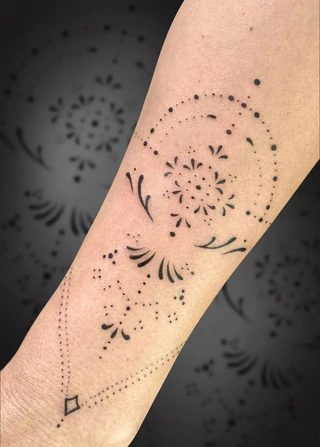
A lotus mandala tattoo usually uses both: line work for the petals, dotwork for the shading towards the centre. See our ornamental tattoo.
Thinking about a mandala? Send us a reference and the placement on WhatsApp and get a price the same day. Our Canggu studio in Pererenan is open daily from 9am to 9pm.
Placements that suit symmetry
A mandala is symmetrical, so it looks best where the body is symmetrical too, or where it can wrap around a joint:
- Sternum. Centred between the chest, often with a drop or lotus below. One of the most striking placements, and one of the more sensitive ones.
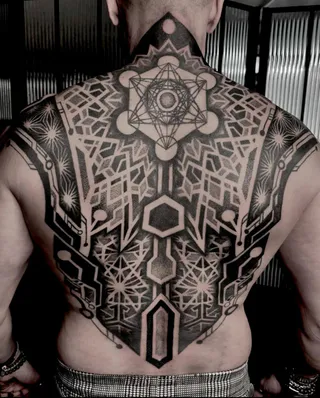
- Spine and upper back. A mandala centred on the spine, sometimes with smaller elements running down it.
- Elbow. A mandala wrapped around the point of the elbow is a classic. It is also a high-movement area, so ask your artist how a design there is likely to age.
- Knee. The same idea on the leg.
- Forearm. Easy to place and show, with room for flowers around it.
- Shoulder cap. The rounded shape suits a full circle.
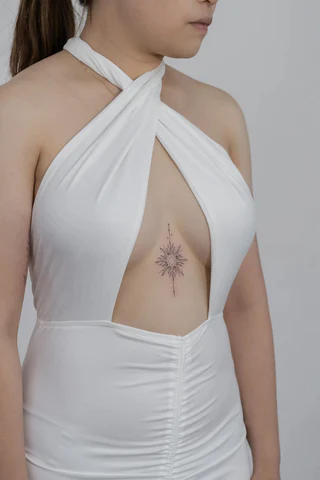
Placement changes the drawing. A mandala on a flat back can be a perfect circle; one on a forearm needs to be drawn slightly oval so it looks round when your arm is turned. That is why the stencil is checked on your body, not just on paper. See our placement guide before you choose.
How mandalas age
Every tattoo softens over the years as the skin renews itself. With mandalas, this shows in two places:
- Tight dotwork can merge. If dots are packed too close, they blur into grey over time. Good dotwork leaves space, so the gradient stays visible.
- Small rings close up. Lots of fine rings in a small mandala can run together. The more detail, the bigger the piece should be.
What keeps a mandala looking crisp:
- Size it for the detail.
- Keep a clear outline around the structure.
- Avoid hands, fingers and feet for detailed work, because those areas fade fastest.
- Protect it from the sun while it heals, then keep protecting it from the sun.
Our article on whether fine line tattoos age well explains more about how lines change, and our guide to tattoo styles compares ornamental work with other styles.
Price and booking
At Amor Fati, small pieces start from IDR 850,000. A medium mandala of 5 to 10cm usually lands between 3M and 9M IDR, and large pieces such as a sternum or back mandala sit in the larger ranges or are booked as full days. We price per design, never per hour, and custom design is included. See our price guide for the full list.
Send us your reference, the size and the placement on WhatsApp and we will reply with an honest price range the same day. All three studios, in Canggu, Uluwatu and Seminyak, are on the studio page.
How long does a mandala tattoo take? It depends on size and how much dotwork is in it. A small forearm mandala can fit in one sitting, while a sternum or back mandala can be a full day or more. Your artist tells you the expected time when they quote.
Does dotwork hurt more than line work? It feels different rather than worse for many people: dotwork is lots of small taps instead of a continuous line. Pain is personal, and placement usually makes a bigger difference than technique.
What does a lotus mandala tattoo mean? The lotus grows from mud and opens clean, so it stands for growth and a fresh start. Combined with a mandala, it usually means balance found after a hard time.
Do mandala tattoos have religious meaning? Mandalas come from Hindu and Buddhist traditions, where they are used in meditation and ritual. Many people wear one as a personal symbol of balance. If you want a specific sacred design, it is worth learning what it represents first.


