


Jagua Tattoo vs Henna: Temporary Ink Before a Real Tattoo
Jagua and henna are temporary stains, not tattoos. Here is how they differ, what to ask before trying one, and how a temporary design can help you decide on a permanent tattoo.

A jagua tattoo is a temporary stain made from the juice of the jagua fruit. It goes on the skin as a gel and develops into a blue-black colour that looks a lot like real tattoo ink, then fades as your skin renews itself, typically over a week or two. Henna is a temporary stain too, but it develops in reddish to brown tones. Neither is a tattoo: no needle, no ink under the skin, nothing permanent.
Our studios are tattoo and piercing studios, and this page is about temporary stains. A temporary design is a useful way to live with an idea before you commit, so here's how the two compare and how to use them as a trial run.
Jagua vs henna: the differences
Colour
- Jagua develops into a dark blue-black, close to the look of black tattoo ink.
- Henna develops into orange, red or brown tones, depending on the paste and the skin.
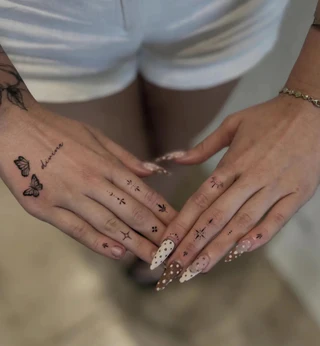
If you want to preview what a black fine line tattoo might look like, jagua gives the closer impression.
How it develops
Both are applied as a paste or gel and left on the skin for a while. The colour isn't fully visible straight away; it darkens over the following hours.
How long it lasts
Both fade as the top layer of your skin renews, usually within one to two weeks. Hands and feet, which are washed and rubbed more, tend to fade faster.
The look
Jagua lines can spread slightly, so very fine detail is harder to achieve than with a tattoo machine. A temporary design gives you the idea and the placement, not a perfect preview of fine line work.
What to watch out for
Temporary doesn't mean risk-free. A few sensible checks:
- Ask what's in it. Products sold as "black henna" may contain added dyes. If a seller can't tell you what's in the paste, skip it.
- Do a small test first if you have sensitive skin or allergies.
- If your skin reacts, with itching, redness, swelling or blistering, wash it off and see a doctor.
- Keep it away from a fresh tattoo or piercing. Healing skin shouldn't have anything applied to it except what your artist's aftercare guidance names.
Using a temporary design to test a tattoo idea
This is where jagua and henna are genuinely useful. If you're unsure about a first tattoo, living with a temporary version for a week can answer questions a mirror can't:
- Placement. Do you like seeing it every day? Does it show with your usual clothes?
- Size. Does it feel too big, too small, or right?
- Reaction. How do you feel about people seeing it, at work or at home?
Our placement guide is a good companion to the experiment.
Take photos of the temporary design on day one and again a few days later, and notice how often you look at it. If you still love it when it fades, that's a good sign. A temporary stain isn't a perfect preview of a real tattoo, though. Fine line work looks crisper than a gel line, and your artist can advise on size.
Done testing and ready for the real thing? Send us your design and where you want it on WhatsApp, and we'll suggest a size and give you a price range the same day.
The stencil: a preview on the day
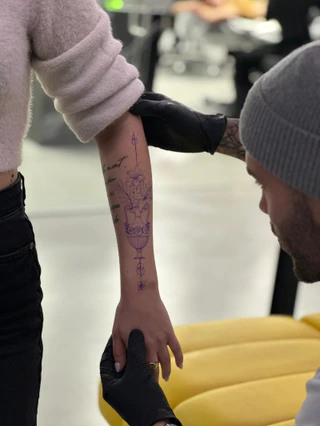
Even without a temporary design, you get a preview before your tattoo. Your artist places a stencil of the design on your skin first, and you check the size and placement in the mirror before the needle. If something looks off, say so.
Jagua, henna and a real tattoo compared
- Jagua: temporary, blue-black, usually gone in one to two weeks, no needle.
- Henna: temporary, reddish-brown, usually gone in one to two weeks, no needle.
- A tattoo: permanent, made with a needle, and needs aftercare while it heals.
If you've decided on a permanent piece, our guide to what your first tattoo session involves walks you through the day, and our fine line tattoo page shows the style many first tattoos are done in.
Getting your first real tattoo in Bali
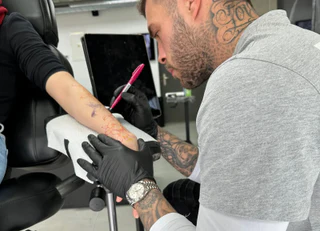
Every tattoo at Amor Fati starts with a design consultation, and the price is agreed before the session. A small fine line piece starts around 850,000 IDR, and a small custom piece of 3 to 5 cm runs 1M to 2.5M IDR. See our Bali tattoo prices guide for every size, and our aftercare guide for Bali for healing on the island.
Quick answers
What is the difference between jagua and henna? Both are temporary skin stains. Jagua develops into a blue-black colour close to tattoo ink, while henna develops into reddish to brown tones.
How long does a jagua tattoo last? Usually one to two weeks, fading as the skin renews. It fades faster on hands and feet.
Is black henna safe? Products sold as black henna may contain added dyes. Ask what's in any paste before it goes on your skin, and see a doctor if your skin reacts.
Can I use a jagua design to plan a real tattoo? Yes. Living with a temporary version for a week can help you decide on placement and size before you book a permanent tattoo.
Book your tattoo
Send us the design you tested, a photo of the placement and the size you liked on WhatsApp. We'll turn it into a tattoo design and give you a price range the same day.
Visit our Canggu studio in Pererenan, or find our Uluwatu and Seminyak studios.


