


Dotwork Tattoo Guide: Technique, Healing and How It Ages
Dotwork builds a tattoo from thousands of small dots instead of lines and solid shading. Here is how the technique works, how it feels and heals, and how it ages over the years.

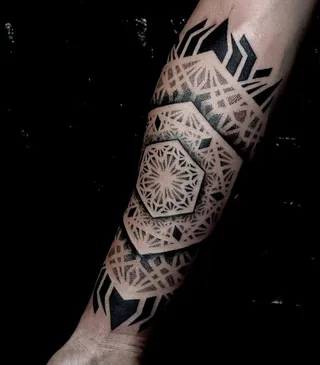
A dotwork tattoo is made from many small dots instead of continuous lines or solid shading. Placing the dots closer together makes an area darker; spreading them out makes it lighter. The technique, also called stippling, gives a gradient with a grainy, hand-drawn texture that smooth shading doesn't reproduce, and it's used for mandalas, sacred geometry, ornamental pieces and shading inside fine line designs.
Here's how dotwork is done, how it feels and heals, and what to expect as it ages.
How does dotwork work?
Instead of dragging the needle to make a line or sweeping it to fill an area, the artist places individual dots, one after another. Shading comes from density:
- Dense dots read as dark areas.
- Spaced dots read as light areas.
- A gradual change in spacing creates a smooth gradient from dark to light.
That's why dotwork has a grainy, almost printed texture up close, and a soft gradient from a distance. It's a slow, careful technique, so dotwork pieces usually take longer to tattoo than a line drawing of the same size.
What designs suit dotwork?
Mandalas
Circular, symmetrical patterns where dotwork shading gives each layer depth. They range from a small circle on the forearm to a full shoulder piece.
Sacred geometry
Interlocking shapes, flowers of life and geometric patterns, with dotwork adding shading inside the shapes.
Ornamental pieces
Lace, filigree and jewellery-like patterns on the spine, sternum or legs. Our ornamental tattoo page shows how dotwork and fine line combine in this style.
Shading in fine line designs
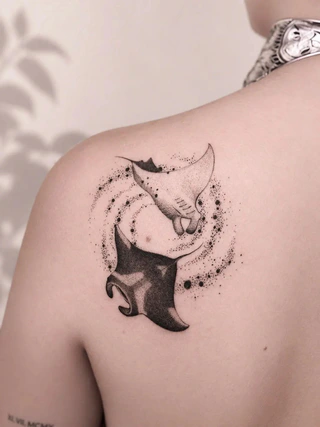
Dotwork isn't only a style in its own right. Many fine line pieces use small areas of dots for soft shading: the shell of a turtle, the body of a manta ray, a sun behind a mountain. You can see this kind of work on our fine line tattoo page.
Animals and nature
Dotwork animals have a distinct, engraved look. Manta rays, turtles and birds suit it well because their shapes are clean and the shading can follow the body of the animal.
Does dotwork hurt more?
Not necessarily more, but differently. Dotwork feels like a steady, repeated tapping rather than the drag of a line. Some people find it easier to sit through; others find the length of the session the harder part. Placement matters more than technique: dotwork on the sternum, the spine or the ribs will feel sharper than on the outer arm.
Considering a dotwork piece? Send us your reference and the placement on WhatsApp, and we'll suggest a size and give you a price range the same day.
How does dotwork heal?
Like any tattoo, it heals best when you follow the aftercare guidance your artist gives you. A few things are specific to dotwork:
- It can look patchy at first. Fresh dotwork can look uneven while the skin settles. Wait until it has healed before judging the gradient.
- Peeling looks grainy. The flakes follow the dots. Let them come off on their own.
- Large pieces mean more skin to protect. A dotwork sleeve or back piece covers a lot of area, so plan your sun and water days carefully.
Every tattoo comes with aftercare guidance for Bali's climate, so ask your artist how to plan your beach days around it. The full plan is in our Bali aftercare guide.
How does a dotwork tattoo age?
Every tattoo softens over the years as the ink settles in the skin. With dotwork, that softening blends neighbouring dots slightly, which can make the gradient smoother over time. What matters most for ageing well:
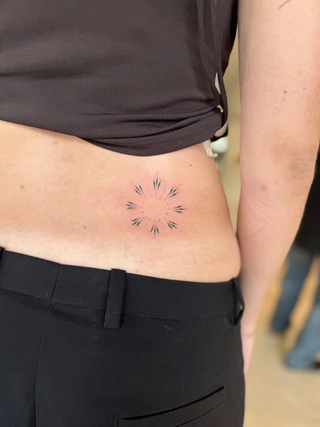
- Size. Very tiny dotwork with dots packed into a small area can merge into a grey patch. Give the shading room.
- Contrast. A design with clear dark and light areas holds up better than one that's all mid-tone.
- Sun. Once healed, cover it or use sunscreen on long beach days. Sun is hard on any tattoo.
Our guide on whether fine line tattoos age well covers the same principles for delicate work.
Dotwork versus other shading styles
- Dotwork gives a grainy, textured gradient.
- Smooth black and grey shading gives a soft, painterly gradient, common in realism.
- Solid blackwork uses flat black areas with no gradient at all.
Each suits different designs. Our guide to tattoo styles explained puts them side by side.
How much does a dotwork tattoo cost in Bali?
At Amor Fati we price per design, never per hour, and dotwork sits within our geometric, blackwork and fine line work. Because it is slower to tattoo, a dotwork piece usually quotes towards the upper end of the range for its size. For reference, a small fine line piece starts around 850,000 IDR, a small custom piece of 3 to 5 cm runs 1M to 2.5M IDR, a medium piece of 5 to 10 cm runs 3M to 9M IDR, and large work of 10 to 20 cm runs 5M to 15M IDR. Sleeves and back pieces are multi-session projects, and full-day sessions start from 10M IDR. See the full Bali tattoo price list.
Quick answers
What is the difference between dotwork and stippling? They describe the same technique: building shading from many small dots. Stippling is the older art term; dotwork is the name usually used for the tattoo style.
Does dotwork take longer than other tattoos? Usually, yes. Placing dots one by one is slower than pulling lines or sweeping shading, so a dotwork piece often needs more time than a line drawing of the same size.
Does dotwork fade faster? Not necessarily. All tattoos soften over time. Dotwork ages best when it has enough size and clear contrast between dark and light areas.
Can dotwork be combined with fine line? Yes. Many fine line designs use small areas of dotwork for soft shading, and ornamental pieces often mix the two.
Book your dotwork tattoo
Send us your design idea and where you want it on WhatsApp. We'll plan the shading and the size with you and give you a price range the same day.
Visit our Canggu studio in Pererenan, or find the studio nearest you in Uluwatu or Seminyak.


