


Buddha Tattoo: Meaning, Respect and Respectful Placement
A Buddha tattoo means a lot to many people, and where it sits on the body matters. Here is what it means, which placements are respectful, and alternatives to consider.

A Buddha tattoo usually stands for calm, awareness and the path towards letting go of suffering. For many people it marks a practice, a turning point or a trip. It is also a tattoo where placement matters: in many Buddhist cultures, an image of the Buddha below the waist or on the feet is seen as disrespectful.
If you want a Buddha tattoo, the meaning and the placement go together. This guide covers both, plus respectful alternatives if you're not sure.
What does a Buddha tattoo mean?
The Buddha represents the teacher who reached enlightenment, and a tattoo of him is usually about the ideas he stands for rather than worship. The most common meanings people bring to us are:
- Peace and calm. A reminder to slow down and stay present.
- Letting go. Of anger, of attachment, of a hard period of life.
- A practice. Meditation, yoga or a spiritual path someone follows.
- A place. A trip through Asia that changed how someone sees things.
The pose matters too. A seated, meditating Buddha is associated with calm. A reclining Buddha is linked to the end of his earthly life. The hand positions, called mudras, each carry their own meaning, so it's worth reading about the one in your reference before you choose it.
Why placement matters for a Buddha tattoo
In many Buddhist cultures, images of the Buddha are treated with great respect, and the head is seen as the highest part of the body and the feet as the lowest. That's why a Buddha on the lower leg, the ankle, the foot or below the waist can come across as disrespectful. If you're travelling in the region, it's worth reading about local customs before you go.
Placements that keep the image above the waist are the respectful choice:
- The upper back or between the shoulder blades.
- The upper arm or shoulder.
- The chest.
- The forearm, which many people choose, though you may want to cover it when visiting temples.
As general guidance, respectful placement avoids the feet, ankles, lower legs, hips and anything below the waist.
The same courtesy applies in Bali: cover a visible Buddha tattoo when you visit a temple, as you would cover your shoulders and legs anyway.
Respectful alternatives to a Buddha image
If the meaning matters more to you than the figure itself, there are symbols that carry similar ideas with less risk of offence.
The lotus
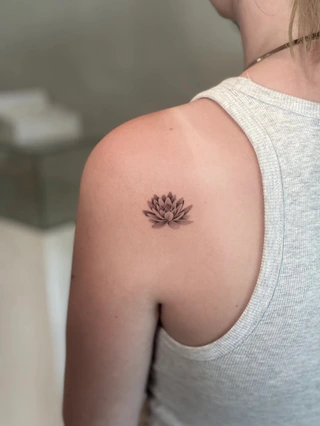
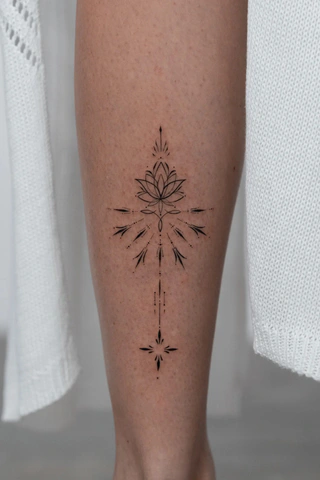
A lotus grows out of mud and opens clean, which is why it stands for growth through difficulty. It suits fine line beautifully and can go almost anywhere on the body.
The unalome
A spiral that straightens into a line, representing the path from confusion to clarity. It's often combined with a lotus at the top.
The Om
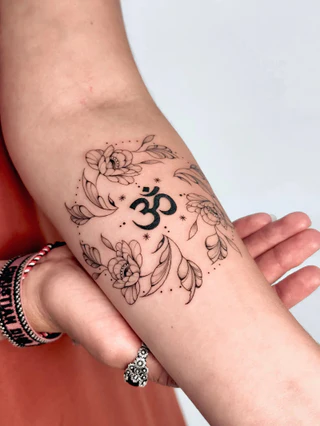
A sacred sound and symbol in Hinduism and Buddhism. Like the Buddha, it deserves a respectful placement, so the same rules apply: not on the feet, not below the waist.
The Bodhi leaf
The leaf of the tree under which the Buddha is said to have reached enlightenment. A simple, quiet design.
Not sure which fits you? Tell us what the tattoo means to you on WhatsApp, and we'll suggest designs and placements that respect it, with a price range the same day.
Choosing a style for a Buddha tattoo
- Black and grey realism suits a detailed face or full figure, with soft shading. It needs space, so the upper arm, chest or back work best.
- Fine line keeps the figure light and minimal, often just an outline. Good for a smaller piece on the forearm or upper back.
- Conceptual designs combine the Buddha with other symbols, like the piece in the photo at the top of this page. Our conceptual tattoo page shows more of this kind of work.
Whatever the style, avoid putting the figure in a joke, a cartoon or a mash-up you wouldn't show a monk.
Getting a Buddha tattoo in Bali
Every tattoo at Amor Fati starts with a design consultation, so the meaning and placement are agreed before anything is drawn. Your artist will talk you through the placement as part of that.
At our studios, tattoos are priced per design, never per hour. A small fine line piece starts around 850,000 IDR, a small custom piece of 3 to 5 cm runs 1M to 2.5M IDR, and a medium piece of 5 to 10 cm runs 3M to 9M IDR. Larger realism pieces are quoted per project. See what tattoos cost in Bali for the full list, and our guide to tattoo styles if you're still choosing one.
Quick answers
Is it disrespectful to get a Buddha tattoo? Not in itself, but placement and intent matter. Keep the image on the upper body and treat it with respect. A Buddha on the feet, lower legs or below the waist is seen as disrespectful in many Buddhist cultures.
Should I cover my Buddha tattoo at temples? It's a respectful habit. You'll be covering shoulders and legs at temples in Bali anyway, and covering a visible Buddha tattoo fits with that.
What is a respectful alternative to a Buddha tattoo? A lotus, an unalome, a Bodhi leaf or an Om carry similar meanings. They still deserve respectful placement, especially the Om.
Where is the best place for a Buddha tattoo? The upper back, shoulder, upper arm or chest. These are above the waist and easy to cover when you visit a temple.
Ask us about your design
Send us your reference and where you'd like it on WhatsApp. We'll help you choose a respectful placement and give you a price the same day.
Visit our Canggu studio in Pererenan, or find the studio nearest you in Uluwatu or Seminyak.


