


Ornamental Tattoo Ideas: Designs That Follow the Body
Ornamental tattoos are designed around the shape of the body. Here are the placements and patterns that work best, from spine and sternum pieces to ankle and hand ornaments.

An ornamental tattoo is a decorative design built from patterns: filigree, lace, mandalas, dots, drops and symmetrical lines. What sets it apart from other styles is that the design is drawn for the body part it sits on. A good ornamental piece follows the spine, frames the sternum, wraps an ankle or traces the curve of the ribs, so it looks like it belongs there.
Here are the ornamental tattoo ideas that work best, placement by placement.
What is an ornamental tattoo?
Ornamental tattoos borrow from jewellery, architecture, textiles and old decorative art. They're usually black, and they mix fine line, dotwork and small areas of solid black. Most are symmetrical, which is why they suit the centre lines of the body so well.
The style overlaps with a few others:
- Fine line ornamental uses thin lines and small dots for a delicate, lace-like look.
- Dotwork ornamental builds shading from many small dots, for softer gradients.
- Blackwork ornamental uses bolder, solid black shapes for a stronger graphic look.
You can see the full range on our ornamental tattoo page, and our guide to which tattoo style is right for you puts ornamental next to the other styles.
Ornamental tattoo ideas by placement
Spine
A vertical line of ornaments, drops, suns or moon phases running down the spine is a favourite ornamental piece. The spine gives a natural centre line for a symmetrical design to follow. It's also easy to hide.
Sternum and under the chest
A sternum piece frames the centre of the chest with a symmetrical pattern that spreads outwards. It's a striking placement, and many people describe it as one of the more intense to sit through, so talk it over with your artist.
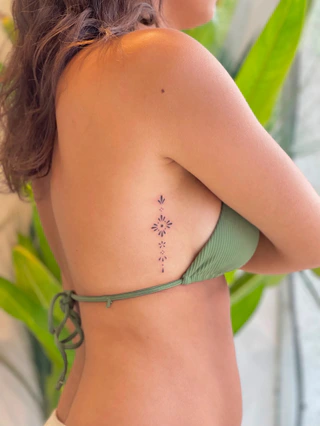
Ribs and waist
Drops, lace and small chandelier-like ornaments that follow the curve of the ribs or the waist. These suit fine line and look elegant from the side.
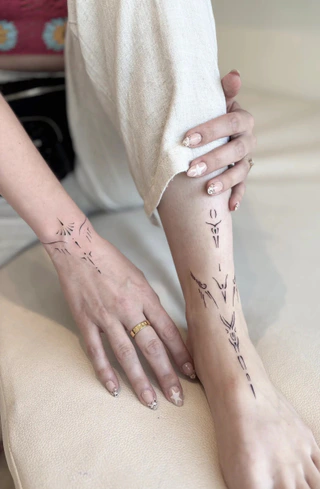
Ankles, feet and hands
Small ornaments that wrap an ankle like an anklet, or trace the top of the hand like a piece of jewellery. They look beautiful when fresh. Ask your artist how these placements wear over time before you choose one.
Backs of the legs
Matching designs down the backs of both calves or thighs, like the sun and moon pair at the top of this page. Pairs work well here because the legs give you two mirror-image canvases.
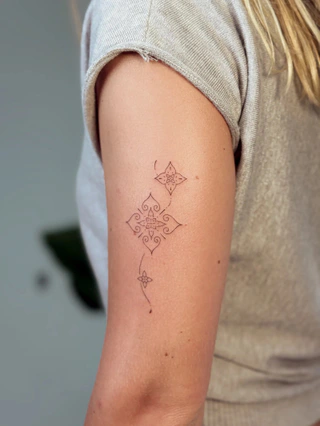
Shoulders and upper arms
A mandala or medallion on the shoulder cap, or a band of ornaments around the upper arm. These areas move well with ornamental shapes and are easy to show or cover.
How an artist makes ornamental work follow the body
Ornamental tattoos are drawn for your body, not just placed on it. That usually means:
- Your centre lines. For a spine or sternum piece, the artist aligns the design to your centre line as closely as your body allows.
- Fitting the stencil while you stand naturally. The body changes shape when you lie down, so the stencil is checked standing up.
- Adjusting the design to your proportions. A design made for one back won't sit the same way on another.
That is why a reference from social media is a starting point, not a final design. Send us what you like and we'll adapt it to your shape.
Fine line or dotwork for ornamental pieces?
- Fine line gives the lightest, most delicate result. Very small detail needs enough space to stay crisp.
- Dotwork gives soft shading and depth, with a slightly textured look. It takes longer to tattoo.
- A mix of both is common: fine line outlines with dotwork shading inside.
Our fine line tattoo page shows how thin the lines can go, and the guide on how fine line ages explains why size matters.
Healing an ornamental tattoo in Bali
Large ornamental pieces on the back or sternum cover more skin, so the beach days need more planning. Every tattoo comes with aftercare guidance for Bali's climate, so ask your artist how to plan your beach days around it. The full routine is in our Bali aftercare guide.
How much does an ornamental tattoo cost in Bali?
We price per design, never per hour. A small ornament on the ankle or wrist starts around 850,000 IDR. A small custom piece of 3 to 5 cm runs 1M to 2.5M IDR, a medium piece of 5 to 10 cm runs 3M to 9M IDR, and a large spine or sternum piece of 10 to 20 cm runs 5M to 15M IDR. The full breakdown is in our Bali tattoo cost guide.
Quick answers
What is the difference between ornamental and geometric tattoos? Geometric tattoos are built from shapes and lines with a mathematical feel. Ornamental tattoos are decorative, inspired by jewellery, lace and mandalas, and usually designed to follow a body part.
Do ornamental tattoos hurt? Pain is personal and depends on the placement. Many people describe spine, sternum and rib pieces as more intense than shoulder or calf pieces. Your artist can help you choose a placement that suits you.
Can you make an ornamental tattoo symmetrical on my spine? That is the aim. Your artist aligns the design to your centre line as closely as possible, and bodies are rarely perfectly symmetrical, so talk it through with them.
Do ornamental hand tattoos last? Hands and fingers are placements to discuss with your artist first, because they rub and get washed often. Ask how they tend to wear before you book.
Book your ornamental tattoo
Send us your reference, the placement and a photo of the area on WhatsApp. We'll adapt the design to your body and give you a price range the same day.
Come in to our Canggu studio, or see all our Bali studios in Uluwatu and Seminyak.


