


Tattoo Stencil Explained: Your Design Before the Needle
The stencil is the moment your design meets your body. What a tattoo stencil is, how it gets from drawing to skin, what to check in the mirror, and why it is worth taking your time.

A tattoo stencil is a temporary outline of your design, transferred onto your skin before the tattoo starts. It shows exactly where the tattoo will sit, how big it is and how it moves with your body, and it gives the artist a guide to follow. The stencil is the last moment you can change the placement, the angle or the size easily, so it is worth taking your time with it.
This guide explains how a design becomes a stencil, how the stencil is placed, what to check before you say yes, and how designing a tattoo works with us. If it is your first tattoo, our step-by-step guide to your first tattoo session covers the rest of the day, and our tattoo aftercare guide covers what comes after.
How to design a tattoo before the stencil
The stencil starts with a design. At Amor Fati custom design is included in the price of every piece, and you approve the design before the session. The process starts on WhatsApp:
- A reference. A photo, a sketch or a screenshot of something you love.
- A rough size. Smaller than a credit card, palm-sized, half a forearm.
- The placement. A photo of the spot helps more than a description.
Your artist turns that into a drawing for your body. Expect some honest suggestions: we often recommend going slightly bigger than a tiny reference, or leaving a little more space between details, so the tattoo has room. For bigger or more detailed pieces, a design consultation with your artist comes first, and the exact price is agreed before the needle touches skin.
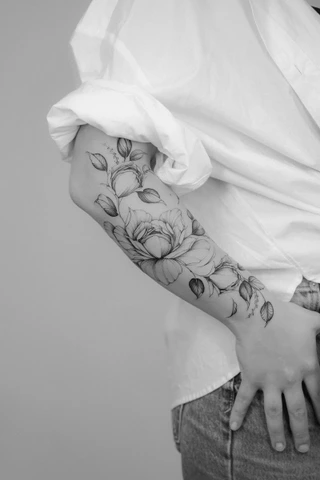
How a tattoo stencil is made
Once the design is final, it is turned into a line drawing that can be transferred to skin. In most studios today this is done with thermal stencil paper: the design is printed or traced onto special paper that carries a purple transfer layer. Fine details are simplified into the lines the artist will actually tattoo, with shading usually left for the artist to build freehand.
Some designs are drawn straight onto the skin instead, especially pieces that need to follow the body closely, such as a floral wrap around an arm or a design down the ribs.
How the stencil is placed
The area is cleaned and prepared, and the stencil is pressed onto your skin, then peeled away to leave the purple outline. Then comes the important part: you look at it.
- Stand the way you normally stand. A stencil on the ribs looks different lying down than in the mirror.
- Move. Bend your arm, turn your wrist, lift your shoulder. The design should still sit where you want it.
- Check from a distance. Step back from the mirror. Is the size right for the space?
- Check symmetry. For a spine or collarbone piece, ask the artist to check that it is straight with your body, not just with the paper.
If something is not right, say so. The stencil can be moved, resized or redrawn, and a few extra minutes now are worth it. Send us your idea and placement on WhatsApp and get an honest price range the same day.
Ask Amor Fati Canggu about a custom design
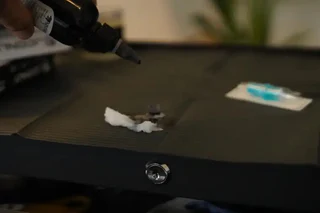
Why you should take your time with the stencil
A tattoo stays. A stencil can be wiped off. That is the whole reason to slow down here.
People sometimes feel they are holding things up by asking for a change. You are not. A good artist would rather move a stencil three times than tattoo something you are unsure about. If you have any doubt about the size, the angle or the exact position, say it before the needle starts.
Lettering needs extra checks
For script and quotes, read the stencil back letter by letter. Check the spelling, the line breaks and any punctuation. Words in another language are worth checking with a native speaker before your session.
Placement changes the design
Designs that look straight on paper can look tilted on a curved forearm or a calf. Your artist may adjust the angle so the tattoo looks right on your body, which is the point of the stencil.
What happens after the stencil
Once you are happy, the session starts. At Amor Fati every tattoo is done with single-use needles opened in front of you and premium inks, and you leave with aftercare guidance for Bali's climate. We also stay on WhatsApp while it heals.
Price and booking
We price per design, never per hour, so time spent getting the stencil right never changes what you pay. Small fine line pieces start from IDR 850,000 at all three studios, a small custom piece of 3 to 5 centimetres usually runs IDR 1,000,000 to 2,500,000, and card payments carry a 3% surcharge. The full list is in our guide to Bali tattoo prices, and our fine line page and floral page show the kind of custom work we draw.
Canggu and Uluwatu are open daily from 9am to 9pm, and Seminyak from 9am to midnight. Our original studio is in Pererenan; the Canggu studio page has the map.
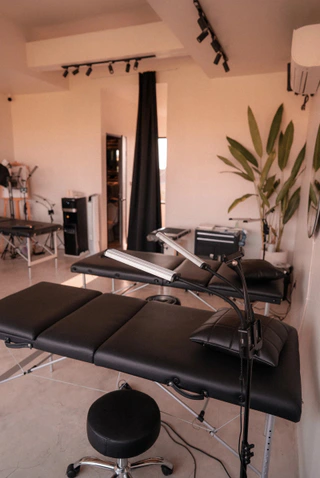
Start your design
Send your reference, a rough size and the placement on WhatsApp, and you will get an honest price range the same day. Or message the studio closest to you; directions are on the Uluwatu and Seminyak studio pages.
What is a tattoo stencil? A temporary outline of your design transferred onto your skin before the tattoo starts. It shows the exact placement and size, and gives the artist a guide to follow.
Can I ask for the stencil to be moved? Yes. The stencil is the moment to change the placement, angle or size. Look in the mirror, move the area, and say so if anything feels wrong.
Does the stencil wash off? The purple outline fades and is cleaned away during and after the session. Only the tattooed lines stay.
Do I pay more if the stencil takes a long time? Not at Amor Fati. We price per design, never per hour, so the time spent getting the stencil right does not change the agreed price.


